The 5-Minute Play Ritual For Cats
Paris DeesingYour cat is staring at you. Not with love. With judgment.
It's the look every indoor cat parent knows — the one that means "I have 40,000 years of hunting instinct coiled inside me and you're just going to keep scrolling?"
Here's the good news: you don't need an hour of cat aerobics to make that look go away. You need five intentional minutes. Done right, a short daily play ritual can turn a restless, shoe-ambushing, 3 a.m.-zoomies cat into a calmer, more satisfied one — and protect your furniture while you're at it.
Why 5 Minutes Actually Works
Indoor cats aren't bored because they lack time to play — they're bored because they lack the sequence their bodies are built for. In the wild, a cat's hunt is short, intense, and resolves with a catch. That full sequence — stalk, chase, pounce, catch, kill-bite, groom, nap — is what satisfies them.
Most "play" misses the point: a dangling string with no resolution, a laser pointer she never gets to catch. The cat gets activated but never completes the cycle, which is arguably worse than not playing at all.
Five minutes is enough to run the full sequence — if you structure it right.
The 5-Minute Ritual, Step by Step
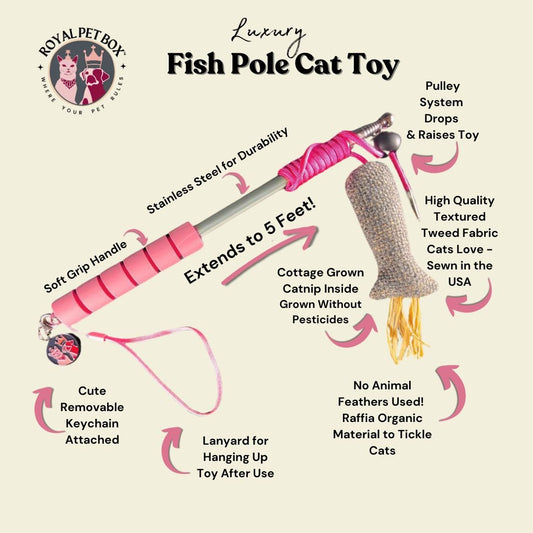
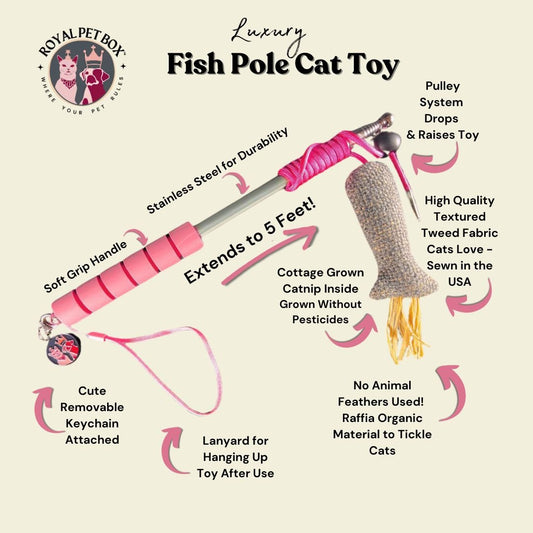
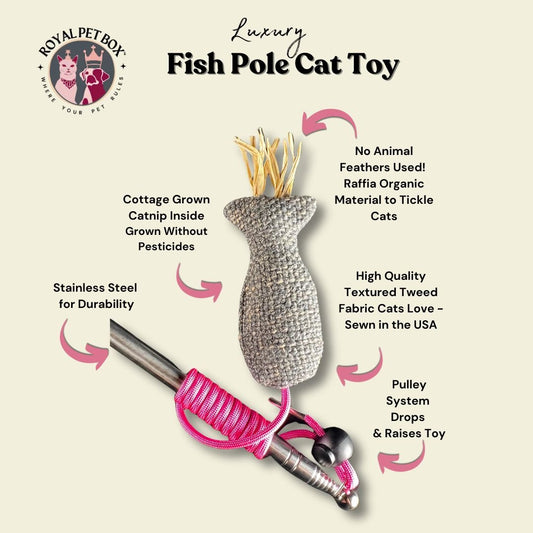
Minute 1 — The Setup (Stalking) Pull out one interactive toy such as the Royal Pet Box Fish Pole Cat Toy. Move the fish toy away from your cat, not toward her. Drag it behind furniture. Let it disappear around a corner. This is the "prey spotted" moment — her pupils will dilate, her shoulders will drop, her tail will go still. Don't rush it.

Minutes 2–3 — The Chase Now let her work. Use quick, unpredictable movements that mimic a real animal's panic: darting, freezing, doubling back. An extendible fishing-pole toy shines here — the reach and height let you create convincing "escape" patterns she can't predict, which is exactly what keeps a cat engaged.
Key rule: let her win sometimes. If she never catches the toy, she'll disengage. If she catches it every time, she gets bored. Aim for three or four "catches" across the session.

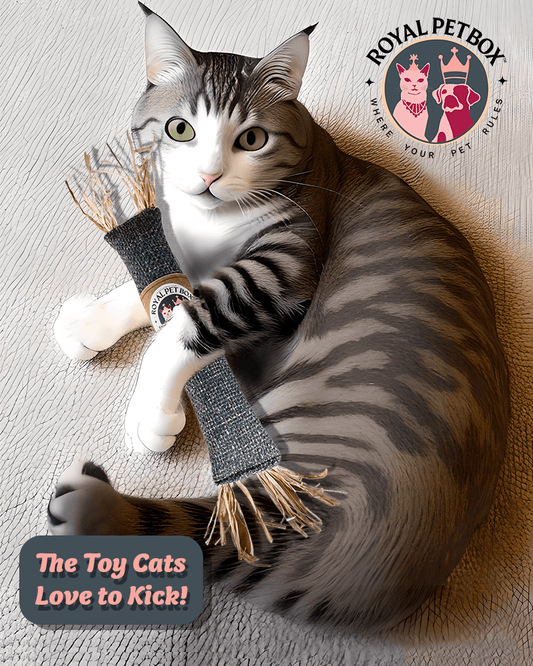
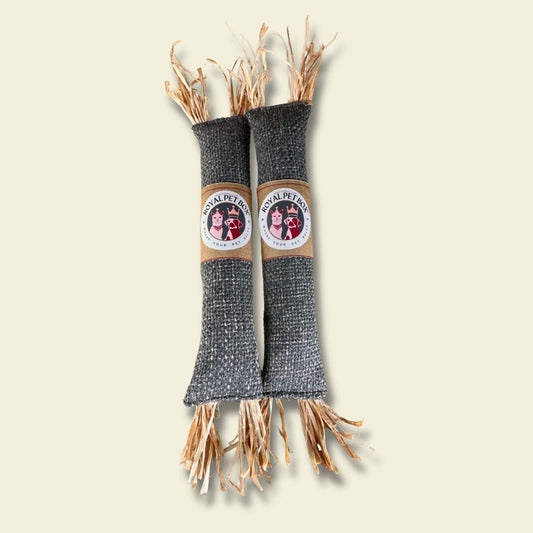
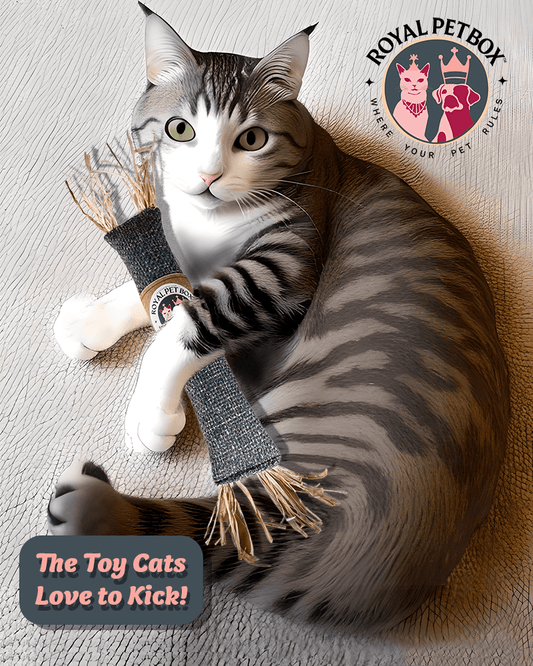
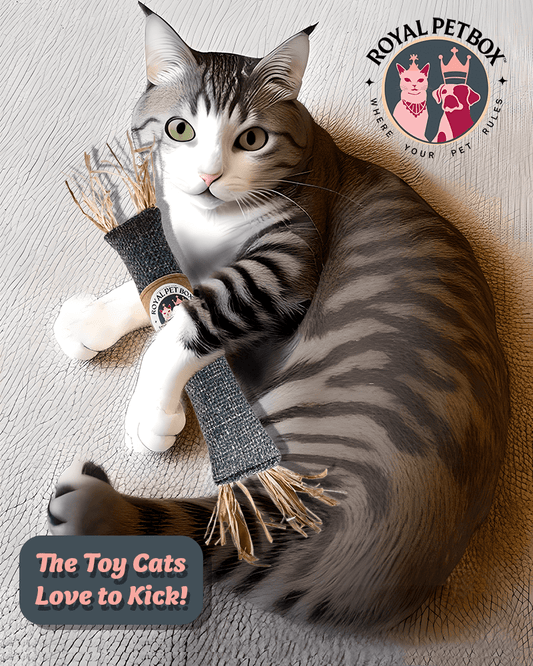
Minute 4 — The Kill Bite Swap to a toy she can bite, kick, and wrestle such as the Royal Pet Box Cat Kicker Toy. A prey-sized kicker toy — roughly the length and weight of a
small rodent, with catnip and silver vine inside — is made for this exact moment. Let her bunny-kick, bite, and body-wrestle it. This is the physical release the whole sequence has been building toward.
Minute 5 — Final Play Then Cool-Down Give her a small treat such as a sprinkle of Royal Pet Box Organically Grown Catnip then let her wind down after a little more

play. Then dinner. In the wild, a hunt ends with a meal, and replicating that pattern triggers the grooming-and-napping response that makes indoor cats calm rather than wired after play. This single step is why so many owners say, "I play with her but she just gets more hyper" — they stop at Minute 4.
Three Mistakes That Sabotage the Ritual
- Playing when you're ready, not when she's ready. Cats hunt at dawn and dusk. Play at 10 p.m. and she'll give you the judgment stare for asking her to work a second shift.
- Using the same toy every day. Novelty is oxygen for feline interest.
- Leaving interactive toys out between sessions. A fishing-pole or kicker toy should be put away when you're done. It preserves novelty and keeps her safe from string ingestion or tangles when you're not supervising.
What Five Minutes Actually Buys You
Cat parents who commit to a real daily play ritual report the same things, almost like a script: fewer nighttime zoomies, fewer furniture casualties, less inter-cat friction in multi-cat homes, and cats who are visibly more relaxed.
Five minutes a day. One completed hunt cycle. A rotating cast of prey-mimic toys. That's the whole secret.
Your cat, in other words, isn't asking for more of your time. She's asking for better five minutes.
Frequently Asked Questions Regarding Cat Play
How long should I play with my indoor cat each day?
Most indoor cats thrive on two structured play sessions of about five minutes each — one in the morning and one in the evening, aligned with their natural dawn-and-dusk hunting rhythms. Quality beats quantity: a single five-minute session that runs the full hunt sequence (stalk, chase, catch, kill-bite, meal) is more satisfying to a cat than thirty minutes of unstructured string-waving. Kittens and high-energy breeds like Bengals or Abyssinians may need three or even four short sessions a day; older or more sedentary cats may do well with one.
What's the best toy for indoor cats?
There isn't one — there are three categories every indoor cat needs. First, a long-reach interactive toy (like the previously mentioned extendible fishing-pole toy) for the chase phase, which lets you create distance, height, and unpredictable prey movement. Second, a prey-sized kicker toy filled with catnip or silver vine, which gives your cat a target to bite, bunny-kick, and body-wrestle at the climax of the hunt. Third, a solo-play toy (crinkle ball, puzzle feeder, or motion-activated toy) for the hours you're not home. Rotating through all three categories prevents the habituation that makes a "best" toy become an ignored toy in three weeks.
Why does my cat get more hyper after playing?
Because the hunt isn't finished. In the wild, a successful hunt ends with a meal, which triggers a calming biological sequence: groom, rest, sleep. If you stop play at the catch — or worse, at the chase — your cat's nervous system is still in "activated" mode with nowhere to discharge that energy. The fix is almost always the same: end every session by offering a small treat or her regular meal. This single step turns post-play zoomies into post-play purring in most cats.
How often should I rotate my cat's toys?
Every two days for interactive toys, and at least weekly for solo-play toys. Keep two-thirds of your cat's toy collection out of sight at any given time, rotating the "active" third on a schedule. Five days out of sight is usually enough for a familiar toy to register as novel again. Store rotating toys in a sealed container with a pinch of fresh catnip so they return smelling — and feeling — new.
Do indoor cats really need daily play?
Yes, and the reason is more than boredom. Without daily prey-sequence play, indoor cats are at higher risk for obesity, urinary tract issues (which are linked to stress), destructive scratching, aggression toward housemates, inappropriate urination, and disrupted sleep cycles that translate to 3 a.m. chaos for you. Five minutes, done well, is one of the highest-leverage things you can do for an indoor cat's physical and mental health — and it costs less time than brushing your teeth.
Is a laser pointer a good cat toy?
Used alone, no. A laser gives your cat the chase without the catch, which is the feline equivalent of going for a run and never being allowed to reach the destination. Used in combination with a catchable toy — a laser chase that ends with her pouncing on a real kicker toy — it becomes a legitimate enrichment tool. The rule: never end a laser session without something physical for your cat to "catch." Also, be careful not to point any lasers at pet or human eyes, at cars, or into the sky due to plane flight risks.
Play is an essential part of a cat’s wellbeing, but every cat has a different fitness level. If your cat is overweight, has joint issues, heart concerns, or is recovering from surgery, talk to your veterinarian before starting a new play routine — they can help tailor session length, intensity, and the right toys for your cat’s specific health profile.
Check out our luxury pet products at reasonable prices. Visit our "Royal Pet Box Pet TV" Channel on both Roku and YouTube for fabulous pet-related education and entertainment.
Paris Deesing holds a degree in Biological Anthropology from UCLA and provides the editorial review behind each article, drawing on a long-held curiosity about the animals who share our lives.
At Royal Pet Box, our Luxury Extendible Fish Pole Cat Toy and Luxury Cat Kicker Toy are designed around exactly this kind of prey-mimic play — handcrafted in the USA, filled with cottage-grown catnip and/or silver vine, built to be the stars of your daily ritual. Your cat's five minutes deserve the royal treatment.
This article was created using artificial intelligence with human editorial review and oversight.