7 Ways to Get Your Cat to Drink More Water (and Why It Matters)
Paris DeesingCats are famously bad at drinking water. If you've ever watched your cat walk past a full bowl for two days, then dramatically drink from a dripping faucet, you've seen the problem firsthand. That low thirst drive isn't stubbornness — it's biology. But in a home built around dry kibble, it can quietly set the stage for urinary problems and kidney strain. Here's how much water cats really need, and seven practical ways to get more of it into them.
Why Cats Are Naturally Poor Drinkers
The domestic cat descends from the African wildcat, a desert-adapted hunter that got nearly all its moisture from prey rather than standing water. A mouse is roughly 70 to 75 percent water, so a wild cat eating several small animals a day is essentially drinking its meals.
That history left cats with a blunted thirst response. They don't feel thirst as urgently as dogs do, and they're poor at compensating when their food is dry. Typical kibble holds only about 6 to 10 percent moisture, against 75 to 80 percent in canned food — so a kibble-only cat has a far bigger gap to close at the bowl, and most never fully close it.

How Much Water Does a Cat Actually Need?
A useful rule of thumb is roughly 3.5 to 4.5 ounces of water per five pounds of body weight per day, counting every source — bowl, fountain, and food. For a ten-pound cat that's about 7 to 9 ounces daily, or roughly a cup. A wet-fed cat may cover half of that at mealtimes; a kibble-fed cat has to find nearly all of it by drinking.
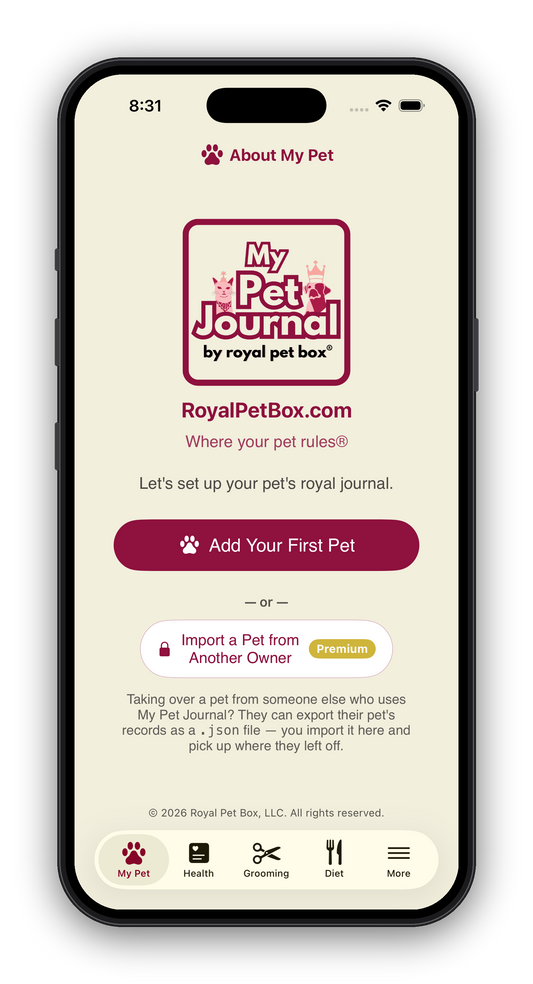
Tracking intake is the kind of quiet baseline that pays off years later — our My Pet Journal gives you one place to log food type, bowl refills, litter box output, and vet notes, so a gradual shift in drinking habits shows up as a pattern instead of a hunch.
These amounts are starting points for a healthy adult cat — pregnancy, kidney disease, hyperthyroidism, diabetes, and certain medications all shift the target, so your vet is the right person to set a number for your particular cat.
7 Ways to Get Your Cat to Drink More Water
- Add wet food to the rotation. This is the single highest-impact change. Even swapping one daily meal from kibble to canned food meaningfully raises total water intake without asking your cat to change any habits.
- Switch to a wide, shallow bowl. Deep, narrow bowls press against a cat's whiskers while they drink, which many cats find genuinely unpleasant. A wide ceramic or stainless dish lets them drink without their whiskers touching the sides.
- Move the water away from the food. In the wild, water beside a carcass is likely contaminated, and cats still carry that instinct. Put the bowl across the room — or in another room — and well away from the litter box.
- Add more water stations. One station per cat plus one extra, spread across the house. A bowl your cat walks past ten times a day gets used; a bowl in the basement does not.
- Try a pet fountain. Plenty of cats prefer moving water, and for faucet-drinkers it's often an instant win. Not every cat converts — and a neglected fountain is worse than a clean bowl, so keep it on a cleaning schedule.
- Mind the material. Ceramic, glass, and stainless steel stay cleaner than plastic, which scratches, harbors bacteria, and is associated with feline chin acne. Wash bowls and change the water daily.
- Stir water into meals. A tablespoon or two of warm water mixed into canned food adds moisture and boosts aroma at once. Some cats also go for a low-sodium, onion- and garlic-free broth, or an ice cube on a hot afternoon.

Spotting the Warning Signs of Dehydration
A dull, dry-feeling coat is often the first thing owners notice, which is one more reason a short grooming session earns its keep — running our Luxury Dog and Cat Brush through your cat every few days puts your hands on their coat often enough to catch a change early.
Beyond coat quality, watch for tacky gums, sunken eyes, lethargy, reduced appetite, constipation, and small, hard clumps in the litter box. The classic skin-tent test — gently lifting the scruff and watching how fast it settles — is a rough indicator, though less reliable in older or very thin cats.
Sudden increased thirst deserves just as much attention. A cat that starts emptying the bowl or hanging around the sink may be signaling kidney disease, hyperthyroidism, or diabetes. And a male cat straining in the litter box without producing urine is a true emergency — a urinary blockage can turn life-threatening within hours.
If you notice any of these changes, please get your cat in front of a veterinarian rather than waiting to see whether the water tricks help — hydration support is a good habit, but it isn't a treatment for an underlying condition.
Small Changes, Long-Term Payoff
You don't need to overhaul anything. Move the bowl, widen it, add a second one, and work some wet food into the week — four changes that cost almost nothing and cover most of the gap between what your cat drinks and what your cat needs. Hydration never announces its payoff; you simply end up with a cat whose kidneys and urinary tract have had an easier time of it for a decade. That's a trade worth making.
Check out our luxury pet products at reasonable prices. Visit our "Royal Pet Box Pet TV" Channel on both Roku and YouTube for fabulous pet-related education and entertainment.
Paris Deesing holds a degree in Biological Anthropology from UCLA and provides the editorial review behind each article, drawing on a long-held curiosity about the animals who share our lives.
This article was created using artificial intelligence with human editorial review and oversight.