Metabolic Bone Disease in Reptiles: The Calcium and UVB Mistakes That Cause It
Paris DeesingMetabolic bone disease is the most common — and most preventable — health problem in captive reptiles. It rarely announces itself. A bearded dragon or leopard gecko can look perfectly normal for months while its skeleton is quietly hollowed out from the inside, and by the time an owner spots a bowed leg or a soft jaw, permanent damage is often done. The good news: MBD is almost entirely a husbandry problem, which means the fix is in your hands.
What Metabolic Bone Disease Actually Is
Metabolic bone disease (properly, nutritional secondary hyperparathyroidism) happens when a reptile can't maintain enough calcium in its bloodstream. Blood calcium is non-negotiable — it runs muscle contraction, nerve signaling, and the heartbeat — so when the diet falls short, the body withdraws it from the only reserve available: the skeleton.
Over weeks and months, bone gives way to soft fibrous tissue. Limbs bow under the animal's own weight, jaws lose rigidity, and spines and tails develop kinks — often while the reptile still looks like it's living normally.
The UVB Mistakes That Cause Metabolic Bone Disease
Here's what surprises most new keepers: you can feed a calcium-rich diet and still watch a reptile develop MBD. Calcium isn't absorbed from the gut without vitamin D3, and most reptiles can't get meaningful D3 from food — they synthesize it in their skin using UVB. No usable UVB means no D3, and the calcium passes straight through.
The failures are almost always mechanical:
- UVB filtered through glass or plastic. Ordinary glass blocks nearly all UVB. A bulb above a glass lid, or a reptile basking by a window, delivers light and heat but nothing usable.
- An expired bulb that still looks fine. UVB output declines long before a bulb burns out. Most lamps are rated for six to twelve months — a two-year-old bulb glowing brightly produces almost nothing.
- Wrong distance or wrong strength. UVB intensity drops sharply with distance. A bulb rated for a tall enclosure can overexpose in a short one; the same bulb hung too far away delivers nothing.
- No basking heat. Reptiles need correct body temperature to metabolize D3 and digest food. A cold animal can't use the calcium it eats.
Species matters too. Diurnal baskers like bearded dragons and uromastyx have high UVB requirements. Crepuscular and nocturnal species such as leopard geckos and ball pythons were long assumed to need none, but current research supports low-level UVB for them as well.
Calcium, Phosphorus, and Why the Ratio Matters
Calcium and phosphorus compete. The target is roughly a 2:1 calcium-to-phosphorus ratio across the whole diet, and most feeder insects fail that badly — crickets, mealworms, and superworms are all phosphorus-heavy, sometimes running the ratio backwards.
Two habits close the gap. Gut-loading means feeding insects a calcium-rich diet for 24 to 48 hours beforehand so the nutrition travels through. Dusting means coating feeders in calcium supplement right before feeding. For herbivorous species, greens matter just as much: collard, mustard, turnip greens, and dandelion are excellent, while spinach and beet greens contain oxalates that bind calcium and make it unavailable.
Supplement schedules vary by species, age, and whether your setup provides UVB — and D3 is fat-soluble, so over-supplementing carries real risk rather than being harmlessly extra. Ask a reptile-experienced vet to set the dusting frequency and the calcium-with-D3 versus plain-calcium split for your animal.
Early Signs of MBD in Reptiles
Catching this early changes the outcome. Watch for:
- A soft, rubbery, or swollen lower jaw, sometimes with the mouth not closing fully
- Bowed or thickened front limbs, or reluctance to lift the body off the ground while walking
- Kinks, lumps, or an S-curve in the spine or tail
- Fine tremors or twitching in the toes, limbs, or jaw
- Lethargy, poor appetite, or a climbing species that stops climbing
- In turtles and tortoises, a shell that flexes under gentle pressure, or pyramiding
Tremors and seizures mean blood calcium has dropped into dangerous territory — an emergency, not a wait-and-see situation.
If you see any of these signs — especially twitching, a soft jaw, or a reptile that won't bear weight — book an exotics vet promptly rather than adjusting husbandry and hoping. Bloodwork and radiographs are the only way to see how far the bone loss has gone.

Building a Husbandry Routine That Prevents MBD
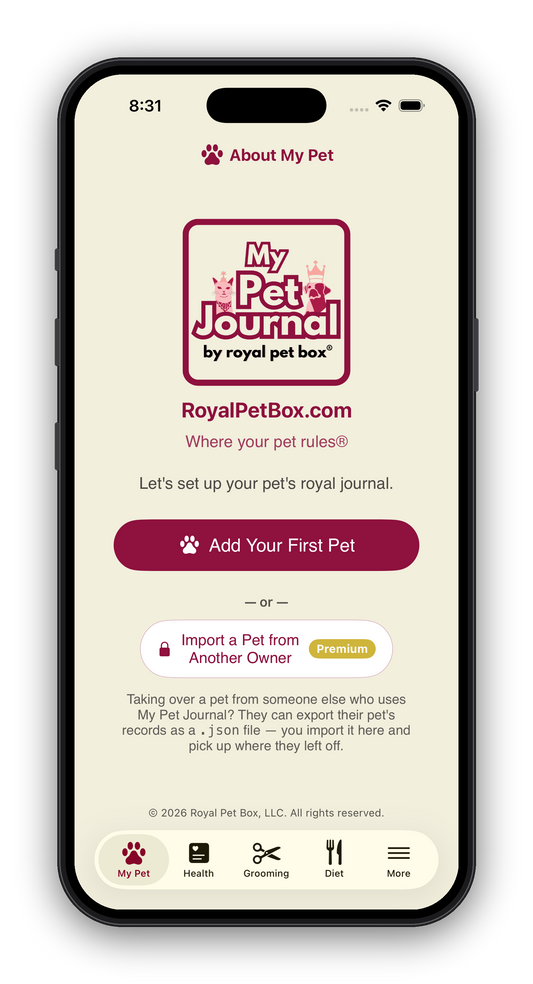
Prevention comes down to a handful of dates and numbers you shouldn't have to keep in your head — our My Pet Journal gives you one place to log bulb install dates, basking temperatures, supplement schedules, and weight checks, so a bulb that quietly aged out doesn't slip past you.
Build it around four things: write the install date on every UVB bulb and replace it on schedule rather than when it dies; confirm the bulb has an unobstructed path to your reptile, since mesh reduces UVB and glass eliminates it; verify basking and cool-side temperatures with a probe or infrared thermometer, not a stick-on dial; and weigh your reptile monthly, because weight change is often the first measurable sign the setup has drifted.
The Bottom Line for Reptile Keepers
Metabolic bone disease is a slow failure of husbandry, not bad luck — which is encouraging, because every input is one you control. Working UVB, correct temperatures, a sane calcium-to-phosphorus ratio, and a habit of writing things down prevent nearly every case. Deformity that's already formed won't straighten out, but reptiles caught early often live full, active lives once the setup is corrected. If something about your reptile's posture, jaw, or energy has been nagging at you, that instinct is worth acting on.
Check out our luxury pet products at reasonable prices. Visit our "Royal Pet Box Pet TV" Channel on both Roku and YouTube for fabulous pet-related education and entertainment.
Paris Deesing holds a degree in Biological Anthropology from UCLA and provides the editorial review behind each article, drawing on a long-held curiosity about the animals who share our lives.
This article was created using artificial intelligence with human editorial review and oversight.