Why Does My Dog Tilt Its Head? The Sweet Science Behind a Beloved Behavior
Paris DeesingFew things melt a dog owner's heart faster than the famous head tilt. You say a word, jingle a treat bag, or play an unfamiliar sound, and suddenly your pup cocks their head sideways with that wide-eyed, quizzical look. So why does your dog tilt its head? It turns out this charming behavior is more than just adorable — it's a clever blend of hearing, vision, listening, and connection.
Below, we'll break down the science behind dog head tilts, when they're a sign of curiosity versus a possible health issue, and how to gently encourage the cute reaction without overdoing it.

Reason 1: Better Hearing and Sound Localization
One leading explanation involves how dogs locate sounds. Dogs have moveable, often floppy ears that can muffle or distort certain frequencies. Tilting the head may help reposition the outer ear (pinna) to better triangulate where a sound is coming from and how far away it is. If you've noticed how often dogs tilt at unfamiliar noises — a doorbell, a squeaky toy, a sudden change in your voice — this is hearing in action. Tracking when and how often your dog reacts to different sounds is easy with our My Pet Journal, a dedicated space to log behaviors, vet notes, training milestones, and quirky moments like these all in one place.
Researchers have also noted that dogs with longer muzzles may tilt more dramatically because their snout can partially block the lower field of view, making angle adjustments useful for both hearing and seeing the speaker.
Reason 2: Reading Your Face and Body Language
Dogs are champion human-watchers. They study our facial expressions, mouth movements, and tone of voice to understand what we want. A head tilt can give them a clearer line of sight to your face, especially around the mouth, where they pick up cues about emotion and meaning. Your dog may tilt its head because it is genuinely trying to read you.
This is why head tilts often appear during conversation, training, or when you say a familiar word like "walk," "treat," or their name. They're processing — and that pause to tilt is part of how they connect the sound to the meaning.

Reason 3: Curiosity, Memory, and Smart Dogs
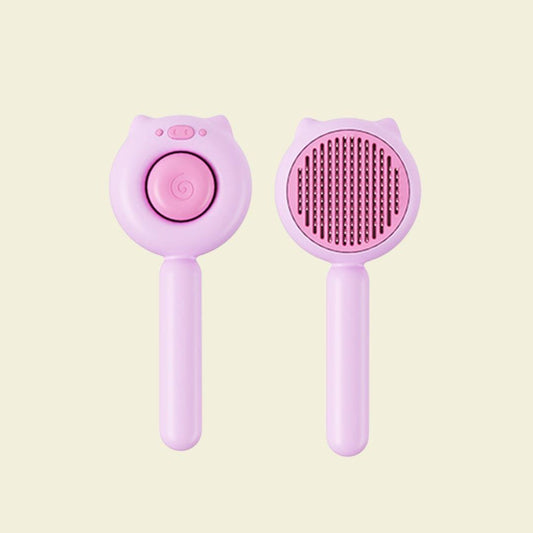
A 2021 study from Eötvös Loránd University found that "gifted word learner" dogs — those able to remember the names of multiple toys — tilted their heads significantly more often when their owner asked for a familiar object. The conclusion: head tilting may be linked to focused listening and memory recall. In short, your dog is thinking. Calm grooming sessions reinforce that focus too; a regular brushing routine with our Luxury Dog and Cat Brush removes loose fur and tangles while building the kind of low-stress connection that makes a dog more attentive to you in everyday interactions.
This is also why some breeds tilt more than others. Border Collies, Poodles, Australian Shepherds, and retrievers often tilt during cue words because they're working hard to match what they hear to what they know.
Reason 4: Positive Reinforcement From You
Let's be honest — when your dog tilts its head, you smile, laugh, and probably say "awwww" in a high-pitched voice. Dogs are remarkably tuned in to your reactions, so this kind of positive feedback can reinforce the behavior. Over time, some dogs learn that tilting earns warm attention or treats, and they begin to do it more often in social situations. It's not manipulation — it's a healthy social loop.
When a Head Tilt Could Signal a Problem
Most head tilting is completely normal and adorable. But there's an important exception: a sudden, persistent, or one-sided tilt your dog can't seem to stop is a different story. This kind of tilt — especially when paired with loss of balance, circling, vomiting, eye flicking (nystagmus), or apparent disorientation — can point to a medical issue such as an ear infection, vestibular disease, head trauma, or a neurological problem.
If your dog's head tilt looks involuntary, lasts longer than a few minutes at a time, or comes with any of the symptoms above, contact your veterinarian. Ear infections and vestibular conditions are very treatable when caught early.
The Bottom Line
Your dog's head tilt is a beautiful little intersection of biology and bond. It helps them hear better, see your face more clearly, and process the words and sounds you make — all while strengthening the connection between the two of you. As long as the tilt is voluntary, momentary, and paired with bright eyes and a relaxed body, you can simply enjoy the moment, snap a photo, and feel flattered: your dog is paying very close attention to you.
An occasional, cute head tilt is normal — but a sudden, persistent head tilt that doesn’t go away can be a sign of an inner-ear infection, vestibular disease, or another medical issue. If your dog is tilting their head all the time, losing balance, or seems disoriented, please consult your veterinarian promptly.
Check out our luxury pet products at reasonable prices. Visit our "Royal Pet Box Pet TV" Channel on both Roku and YouTube for fabulous pet-related education and entertainment.
Paris Deesing holds a degree in Biological Anthropology from UCLA and provides the editorial review behind each article, drawing on a long-held curiosity about the animals who share our lives.
This article was created using artificial intelligence with human editorial review and oversight.